NABH accreditation has become the benchmark for quality in Indian hospitals — and for ICU departments, the documentation requirements are among the most demanding in the entire accreditation framework. The National Accreditation Board for Hospitals & Healthcare Providers, operating under the Quality Council of India, evaluates hospitals against a comprehensive set of standards that touch every aspect of patient care, from admission to discharge. In the ICU, where clinical complexity is highest and the risk of adverse outcomes is greatest, the documentation burden is correspondingly heavy.
The 5th edition of NABH standards, currently in effect, introduced significant changes to how hospitals must document ICU care — including stricter requirements for clinical audit trails, severity scoring, informed consent, and quality indicator reporting. Hospitals preparing for accreditation or reaccreditation frequently discover that their ICU documentation practices, while clinically adequate, fall short of what NABH assessors expect to see during on-site assessments.
This guide covers every major NABH documentation requirement relevant to ICU departments in Indian hospitals, explains the rationale behind each standard, and provides practical strategies for building compliant documentation workflows.

What Is NABH and Why Does It Matter for ICU Documentation?
NABH is the principal accreditation body for hospitals in India. Established in 2006, it sets standards that cover clinical care, patient safety, infection control, medication management, and — critically — documentation practices across all departments. NABH accreditation is voluntary, but it has become effectively mandatory for hospitals seeking empanelment with major insurance companies, participation in government health schemes like CGHS and ECHS, and recognition as a quality healthcare provider.
For ICU departments, NABH accreditation carries particular weight:
- Insurance empanelment. Most TPAs and insurance companies in India require or strongly prefer NABH-accredited hospitals for cashless claims — particularly for high-cost ICU admissions. Inadequate documentation can jeopardise both the accreditation and individual claim approvals. For detailed guidance on TPA-specific documentation requirements, see our guide on ICU discharge summaries for TPA insurance claims.
- Medicolegal protection. NABH-compliant documentation creates the kind of structured, timestamped, attributable records that hold up in consumer court and criminal proceedings. For a deeper analysis of this intersection, see our complete guide to medicolegal documentation in ICU.
- Patient safety. The documentation standards are not bureaucratic exercises — they reflect evidence-based practices that reduce adverse events, improve clinical handoffs, and standardise care delivery.
- Quality benchmarking. NABH-mandated quality indicators allow ICU departments to measure their performance against national and international benchmarks.
NABH accreditation is no longer just a badge — it is a gateway to insurance empanelment, government scheme participation, and patient trust. For ICU departments, documentation is the area where hospitals most frequently fail assessments. The standards are specific, the assessors verify compliance at the bedside, and the consequences of non-compliance extend beyond accreditation to clinical and legal risk.
NABH 5th Edition: Key Standards Relevant to ICU Documentation
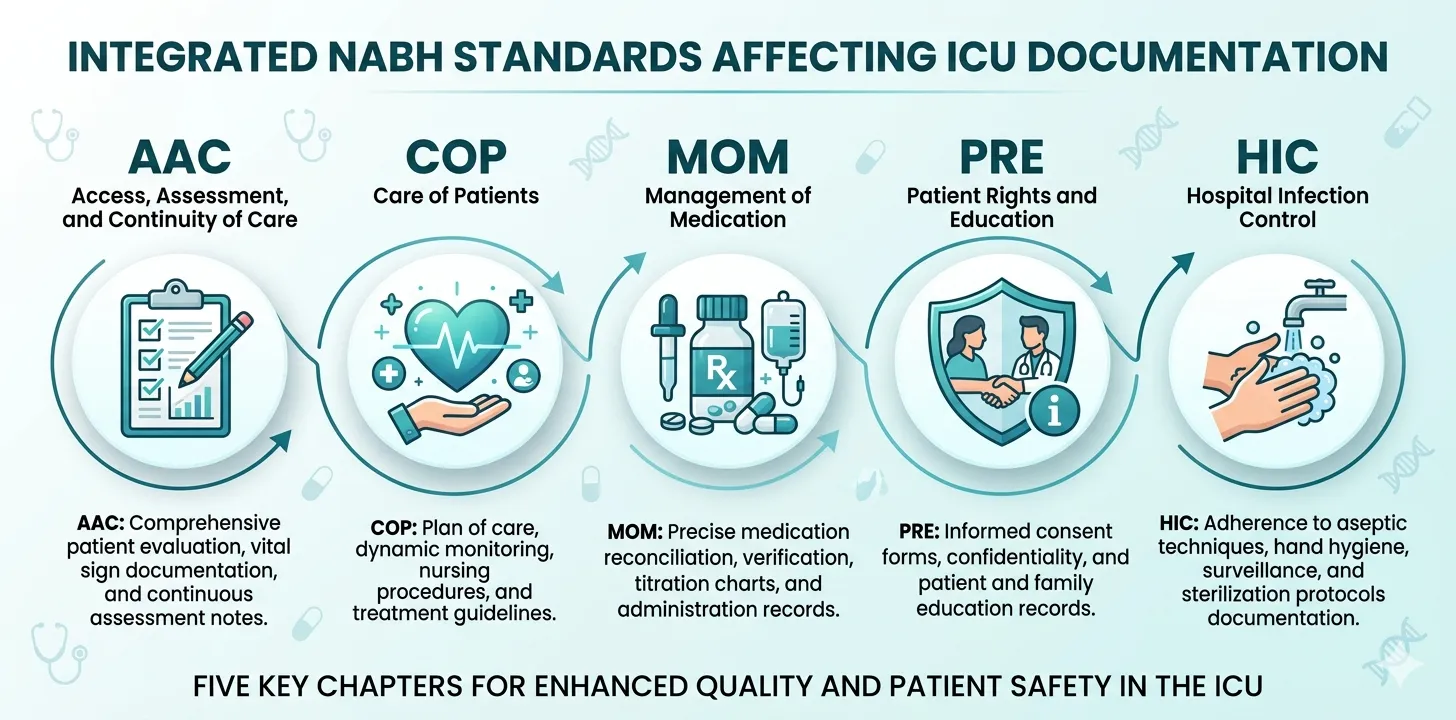
The NABH 5th edition organises standards into chapters covering different functional areas. Several chapters directly affect ICU documentation requirements. Understanding which standards apply — and what the assessors are looking for — is the first step toward compliance.
Chapter 1: Access, Assessment, and Continuity of Care (AAC)
This chapter governs how patients are assessed at admission, how care is planned and delivered, and how continuity is maintained across transitions.
ICU-specific requirements under AAC:
- Initial assessment within a defined timeframe. NABH requires that every ICU patient receives a documented initial assessment by a qualified physician within a timeframe defined by hospital policy (typically within 30 minutes of ICU admission for emergency cases). The assessment must include presenting complaints, history, examination findings, provisional diagnosis, and a care plan.
- Reassessment at defined intervals. Daily reassessment — documented as structured ward round notes — is mandatory. For critically ill patients, the reassessment frequency may need to be higher and must be defined in hospital policy.
- Severity scoring. The 5th edition explicitly expects objective severity assessment. This means documented SOFA scores at admission and serially during the stay, along with APACHE II scores calculated within the first 24 hours. These are no longer optional best practices — they are expected by assessors.
- Discharge planning. Discharge planning must begin at or near admission. The documented care plan should include discharge criteria, expected length of stay, and the anticipated post-ICU care pathway.
NABH assessors will review a sample of ICU patient records during the on-site assessment. They check for the presence of initial assessments, daily reassessments, severity scores, and discharge plans — not just whether these documents exist as templates, but whether they are consistently completed with patient-specific clinical content.
Chapter 2: Care of Patients (COP)
COP standards address the actual delivery of clinical care, including high-risk procedures, pain management, nutritional assessment, and end-of-life care — all of which are routine in the ICU.
ICU-specific requirements under COP:
- Care plans for high-risk patients. ICU patients are, by definition, high-risk. NABH requires individualised, documented care plans that are updated as the patient’s condition changes. A generic “ICU care plan” template that is not customised to the patient will not satisfy this standard.
- Documented consent for procedures. Every invasive ICU procedure — central line insertion, intubation, tracheostomy, chest drain, renal replacement therapy — requires documented informed consent. The consent must specify the procedure, its risks, benefits, and alternatives. For emergency procedures where consent cannot be obtained, the clinical necessity and the reason consent was deferred must be documented.
- Pain assessment and management. NABH requires documented pain assessment using a validated scale (numeric rating scale, visual analogue scale, or behavioural pain scale for sedated patients) at defined intervals. The assessment and any interventions must be recorded in the patient record.
- Nutritional screening and planning. Every ICU patient must be screened for nutritional risk within 24 hours of admission. If at risk, a documented nutritional plan — including route, caloric target, and monitoring — is required.
- End-of-life care. When goals of care shift to comfort measures, the decision, the family discussion, and the modified care plan must be documented. NABH expects evidence that end-of-life decisions are made through a structured process involving the patient’s family and the treating team.
One of the most common NABH non-conformities in ICUs is the absence of documented consent for bedside procedures. Central venous catheterisation, arterial line insertion, and even urinary catheterisation require documented consent or a documented justification for why consent was deferred. “Implied consent” without documentation is not acceptable under NABH standards.
Chapter 3: Management of Medication (MOM)
Medication management documentation in the ICU is complex and high-stakes. NABH standards require:
- Medication reconciliation at admission and discharge. A documented list of the patient’s pre-admission medications must be obtained and reconciled with the ICU medication orders. At discharge, another reconciliation must occur between ICU medications and the discharge prescription.
- High-alert medication protocols. Vasopressors, insulin infusions, anticoagulants, concentrated electrolytes, and sedatives are classified as high-alert medications. Their prescribing, administration, and monitoring must follow documented protocols, and adherence must be recorded.
- Antibiotic stewardship documentation. NABH expects documented evidence of antibiotic stewardship — including culture-guided prescribing, de-escalation when sensitivities are available, and antibiotic review at 48–72 hours.
- Adverse drug reaction reporting. Any suspected adverse drug reaction must be documented and reported through the hospital’s pharmacovigilance system.
Chapter 4: Patient Rights and Education (PRE)
This chapter covers informed consent, patient and family education, and grievance redressal — all areas with direct ICU documentation implications.
- Informed consent. Beyond procedure-specific consent, NABH requires documented general consent at admission covering routine care, teaching activities, and information sharing. For ICU patients who lack capacity, the surrogate decision-maker must be identified and documented.
- Family communication. NABH expects documented evidence that families are regularly informed about the patient’s condition. In the ICU, this means recorded family meetings with date, time, attendees, topics discussed, and the family’s expressed understanding.
- Patient rights information. The hospital must document that the patient or family was informed about their rights — including the right to information, the right to refuse treatment, and the right to a second opinion.
Create a standardised family communication log as part of the ICU record. NABH assessors specifically look for documented evidence of regular family updates. A simple form capturing date, time, attending clinician, family members present, topics discussed, and family’s response satisfies the standard and takes under two minutes to complete.
Chapter 5: Hospital Infection Control (HIC)
Infection control documentation is critical in the ICU, where device-associated infections are a major quality indicator.
- Surveillance data. NABH requires documented surveillance of ICU-specific infections: ventilator-associated pneumonia (VAP), central line-associated bloodstream infection (CLABSI), catheter-associated urinary tract infection (CAUTI), and surgical site infections for post-operative ICU patients.
- Bundle compliance. Documentation of compliance with evidence-based care bundles — ventilator bundle, central line insertion bundle, urinary catheter bundle — must be maintained and auditable.
- Hand hygiene audits. The ICU must maintain records of hand hygiene compliance audits at defined intervals.
- Antibiogram. An annual antibiogram documenting resistance patterns in the ICU must be maintained and used to guide empiric antibiotic selection.
NABH Quality Indicators for ICU
NABH requires hospitals to track and report specific quality indicators for the ICU. These indicators require underlying documentation infrastructure — you cannot report what you do not record.
Mandatory ICU Quality Indicators
| Indicator | What Must Be Documented | Reporting Frequency |
|---|---|---|
| ICU mortality rate | Admission date, discharge/death date, outcome for every patient | Monthly |
| Readmission rate within 48 hours | ICU discharge time, readmission time, reason for readmission | Monthly |
| VAP rate per 1000 ventilator days | Ventilator start/stop dates, VAP diagnosis with clinical criteria | Monthly |
| CLABSI rate per 1000 central line days | Central line insertion/removal dates, CLABSI diagnosis | Monthly |
| CAUTI rate per 1000 catheter days | Urinary catheter insertion/removal dates, CAUTI diagnosis | Monthly |
| Unplanned extubation rate | All extubation events categorised as planned or unplanned | Monthly |
| Reintubation rate within 48 hours | Extubation time, reintubation time, reason | Monthly |
| Pressure ulcer incidence | Skin assessment on admission, daily assessment, any new pressure injuries | Monthly |
| Medication errors | All reported medication errors with severity classification | Monthly |
| Average length of ICU stay | Admission and discharge dates for all patients | Monthly |
Quality indicator reporting is not a separate activity from clinical documentation — it is derived from it. If your ICU documentation does not systematically capture ventilator start/stop dates, central line days, and catheter days, you cannot calculate your device-associated infection rates accurately. The quality indicators are only as reliable as the underlying clinical records.
Clinical Audit Requirements
NABH requires regular clinical audits of ICU documentation quality. The audit must assess:
- Completeness of medical records. Are all required sections present? Are they filled with patient-specific content rather than left blank or completed with generic phrases?
- Timeliness of documentation. Are initial assessments, daily notes, procedure notes, and discharge summaries completed within the defined timeframes?
- Consistency across records. Do the doctor’s notes, nursing records, medication charts, and monitoring data tell a consistent clinical story?
- Compliance with defined protocols. Are care bundles documented? Are medication reconciliations performed? Are severity scores calculated?
The audit results must be documented, discussed in the ICU quality committee, and used to drive measurable improvement actions — all of which must be recorded and available for the NABH assessor.
Structured ICU data that satisfies NABH assessors
Rivara Health captures severity scores, daily clinical parameters, and procedure documentation in a structured format — creating the audit-ready records NABH accreditation demands.
The ICU Medical Record: What NABH Expects to Find
During an on-site assessment, NABH assessors will pull individual ICU patient records and evaluate them against the standards. Here is what a compliant ICU record must contain:
Admission Documentation
- Admission note with history, examination, provisional diagnosis, and ICU admission indication — completed within the timeframe defined in hospital policy
- Severity scores: SOFA score at admission (with component-level values) and APACHE II score within 24 hours
- Comorbidity documentation with current medications (medication reconciliation)
- Informed consent — general consent for admission, specific consent for initial procedures
- Nursing admission assessment including fall risk, pressure injury risk (Braden scale), nutritional screening, and pain assessment
- Initial care plan with identified problems, planned interventions, goals, and expected outcomes
Daily Documentation
- Daily ward round note by the treating physician — including current clinical assessment, interpretation of investigations, and management plan with rationale
- Daily SOFA score with component values and supporting laboratory data
- Nursing documentation — hourly vitals, fluid balance, ventilator parameters (if applicable), GCS or RASS, pain assessment, skin assessment, care bundle compliance
- Medication administration records — documented administration times for all medications, with reason recorded for any held or refused doses
- Procedure notes for any procedures performed that day — including indication, technique, complications, and operator identity
- Family communication record if any interaction occurred
Discharge Documentation
- Comprehensive discharge summary covering the entire ICU stay — clinical course, procedures, complications, final diagnosis, condition at discharge, and follow-up plan
- Medication reconciliation at discharge — comparing ICU medications with the discharge prescription, with documented rationale for any changes
- Discharge severity score — SOFA score at the time of ICU discharge
- Handoff documentation to the receiving ward team, with specific instructions for monitoring and escalation
The single most effective step an ICU can take toward NABH compliance is implementing a structured daily note template that captures all required elements — severity scores, ventilator parameters, vasopressor doses, fluid balance, pain assessment, nutrition, care bundle compliance, and the treating physician’s clinical reasoning. When daily documentation is complete, the discharge summary and quality indicators practically write themselves.
Common NABH Non-Conformities in ICU Documentation
Based on published NABH assessment reports and common patterns observed across Indian hospitals, these are the documentation gaps most frequently flagged during ICU assessments:
1. Missing or Incomplete Severity Scores
Many ICU departments either do not calculate SOFA or APACHE II scores at all, or calculate them inconsistently — with scores present for some patients but not others, or admission scores present without serial daily tracking.
What assessors expect: SOFA score documented at admission, daily thereafter, and at discharge — with the raw laboratory and clinical values that generated each score visible in the record.
2. Generic Care Plans
A standardised “ICU care plan” that is identical across all patients does not meet the NABH standard. Care plans must be individualised, reflecting the specific patient’s diagnosis, organ dysfunctions, and management priorities.
3. Absent or Incomplete Consent Documentation
Consent forms that are signed but lack documentation of the specific risks discussed, or procedures performed without any consent documentation and without a documented emergency justification, are common non-conformities.
4. No Evidence of Medication Reconciliation
Medication reconciliation — comparing pre-admission medications with ICU orders, and ICU medications with the discharge prescription — is a specific NABH requirement that many ICUs do not document even when the clinical process occurs informally.
5. Undocumented Care Bundle Compliance
VAP bundles, CLABSI prevention bundles, and sepsis bundles are expected in NABH-accredited ICUs. The bundle elements must be documented for each applicable patient — not as a generic protocol document, but as a patient-level compliance record.
6. Inadequate Family Communication Records
Many ICUs conduct regular family meetings but do not document them systematically. NABH expects a record of what was communicated, to whom, and the family’s response — for every significant clinical update.
7. Quality Indicator Data Gaps
If the underlying documentation does not capture device days (ventilator days, central line days, catheter days) systematically, the ICU cannot accurately calculate or report its device-associated infection rates — a core NABH requirement.
| Non-Conformity | NABH Standard | Fix |
|---|---|---|
| Missing SOFA/APACHE II scores | AAC — Severity assessment | Implement structured daily scoring with auto-populated lab values |
| Generic care plans | COP — Individualised care | Require patient-specific entries in care plan templates |
| Incomplete consent documentation | PRE — Informed consent | Standardised consent forms with mandatory risk fields |
| No medication reconciliation | MOM — Medication management | Admission and discharge reconciliation checklists |
| Undocumented bundle compliance | HIC — Infection prevention | Daily bundle compliance checklists per patient |
| No family communication log | PRE — Patient/family education | Standardised family meeting documentation form |
| Missing device-day tracking | HIC — Quality indicators | Daily device documentation in nursing records |
NABH assessors do not accept “we do this but don’t document it” as a response. The accreditation principle is explicit: if it isn’t documented, it isn’t done. This is identical to the medicolegal standard — and the overlap is intentional. NABH documentation compliance and medicolegal defensibility are two sides of the same coin.
Building a NABH-Compliant ICU Documentation Workflow
Compliance is not achieved through a last-minute documentation sprint before the assessment visit. It requires a systematic workflow that embeds documentation into daily ICU practice.
Step 1: Define Your Policies and Timeframes
NABH requires that the hospital define (in its policy manual) the timeframes for key documentation events:
- Initial physician assessment after ICU admission (e.g., within 30 minutes for emergencies)
- Daily reassessment timing (e.g., during morning ward rounds)
- Procedure note completion (e.g., within 1 hour of the procedure)
- Discharge summary completion (e.g., within 24 hours of ICU discharge)
- Family communication frequency (e.g., daily updates for critically ill patients)
The hospital is then assessed against its own stated policies — so define realistic timeframes that your team can consistently meet.
Step 2: Implement Structured Templates
Replace free-text documentation with structured templates that include mandatory fields for every NABH-required element. This is the single highest-impact change an ICU can make:
- Admission template: Demographics, diagnosis, indication for ICU, severity scores (with component fields), comorbidities, consent status, initial care plan
- Daily note template: Organ system review, severity score components, ventilator parameters, vasopressor doses, antibiotic review, nutrition, pain assessment, care bundle compliance, clinical reasoning, plan
- Procedure note template: Procedure name, indication, consent status, technique, complications, operator
- Family communication template: Date, time, clinician, family members, topics discussed, family response
- Discharge summary template: All elements as specified in the complete guide to ICU discharge summaries
Step 3: Assign Documentation Responsibilities
Clarify who is responsible for each documentation element:
- Treating consultant or senior resident: Admission assessment, daily ward round note, clinical reasoning, discharge summary
- Procedural operator: Procedure notes
- Bedside nurse: Hourly vitals, fluid balance, ventilator parameters, GCS/RASS, pain assessment, skin assessment, care bundle compliance, device-day tracking, medication administration records
- Duty physician: Family communication documentation, consent documentation
- Quality/infection control team: Surveillance data compilation, audit reports
Step 4: Conduct Regular Documentation Audits
NABH expects evidence of ongoing quality improvement — not just compliance at the time of assessment. Implement monthly documentation audits that review a random sample of ICU records against a standardised checklist:
- Are all required sections present and completed?
- Are severity scores calculated correctly with supporting data?
- Are procedure notes timely and complete?
- Is consent documented for all invasive procedures?
- Are family communications recorded?
- Are care bundles documented at the patient level?
Share audit results in the ICU quality committee meeting (which must also be documented), identify trends, and implement corrective actions with measurable targets.
Step 5: Use Technology to Reduce the Burden
The documentation requirements are extensive, and adding more paperwork to already-burdened ICU clinicians is counterproductive. Structured digital documentation tools can capture the required data as part of the clinical workflow — rather than as an additional administrative task.
When daily clinical data is captured in a structured format, it serves multiple purposes simultaneously: it feeds the clinical record, generates severity scores automatically, populates quality indicator databases, and provides the foundation for comprehensive discharge summaries. This is the approach that makes NABH compliance sustainable rather than aspirational.
NABH-ready ICU documentation — without the paperwork burden
Rivara Health's ICU Summary Generator captures structured clinical data during daily rounds and generates complete, audit-ready discharge summaries — with severity scores, procedure documentation, and clinical reasoning built in.
NABH and Digital Documentation: What Assessors Accept
NABH accepts electronic medical records provided they meet specific criteria:
- User authentication. Every entry must be attributable to a specific, authenticated user.
- Timestamp integrity. System-generated timestamps that cannot be overridden by users. Backdating of entries is not acceptable.
- Append-only design. Previous entries must not be deletable or silently editable. Corrections must be appended as new entries with a reference to the original.
- Availability and backup. Records must be retrievable during the assessment and protected against data loss.
- Regulatory compliance. Electronic records must comply with the Information Technology Act, 2000, and the Bharatiya Sakshya Adhiniyam, 2023, for admissibility as evidence.
NABH does not mandate paper records — but it does mandate that electronic records meet the same standards of completeness, attribution, and integrity. A digital system that generates structured, timestamped, append-only records is not just acceptable — it is preferred by assessors because it is easier to audit and harder to manipulate.
NABH Compliance Checklist for ICU Documentation
Use this checklist to evaluate your ICU’s readiness for NABH assessment:
Policies and Protocols
- ICU admission and discharge criteria documented
- Timeframes defined for initial assessment, daily reassessment, procedure notes, and discharge summaries
- High-alert medication protocols in place and documented
- Care bundle protocols (VAP, CLABSI, CAUTI, sepsis) documented
- Family communication policy with defined frequency
- End-of-life care policy documented
Individual Patient Records
- Initial assessment within defined timeframe
- SOFA score at admission with component values
- APACHE II score within 24 hours
- Individualised care plan — not generic
- Informed consent for all invasive procedures
- Daily ward round notes with clinical reasoning
- Daily SOFA score tracking
- Medication reconciliation at admission
- Nutritional screening within 24 hours
- Pain assessment at defined intervals
- Nursing assessments (fall risk, Braden scale) documented
- Care bundle compliance documented per patient
- Family communication logged with content and attendees
- Complete discharge summary within defined timeframe
- Medication reconciliation at discharge
- Handoff documentation to receiving team
Quality and Audit
- Monthly quality indicator data compiled and reported
- Device-day tracking for ventilators, central lines, urinary catheters
- Infection surveillance data maintained
- Monthly documentation audit conducted with results
- ICU quality committee meetings documented with action items
- Corrective actions tracked to completion
Medical Disclaimer
This article is for informational and educational purposes only. It does not constitute medical advice, diagnosis, or treatment. Always consult a qualified healthcare professional for clinical decision-making. Rivara Health provides documentation tools — clinical judgement remains with the treating physician.
Conclusion
NABH documentation requirements for the ICU are demanding — but they are not arbitrary. Each standard reflects an evidence-based practice that improves patient safety, strengthens clinical governance, and creates records that serve the hospital’s clinical, legal, and financial interests simultaneously. The overlap between NABH compliance, medicolegal defensibility, and TPA insurance documentation is extensive — getting one right largely means getting all three right.
The key to sustainable compliance is embedding documentation into the clinical workflow rather than treating it as an administrative afterthought. Structured daily notes that capture severity scores, ventilator parameters, medications, procedures, and clinical reasoning during ward rounds create the foundation for everything else — comprehensive discharge summaries, accurate quality indicators, and audit-ready records.
For ICU departments preparing for NABH accreditation or struggling to maintain compliance between assessment cycles, the most practical path forward is structured digital documentation that captures the right data at the point of care. Rivara Health’s ICU Summary Generator is built for exactly this purpose — capturing structured clinical data during daily rounds and generating the complete, NABH-compliant documentation that assessors, insurers, and courts expect to see.
Related reading: Medicolegal Documentation in ICU: A Complete Guide | The Complete Guide to ICU Discharge Summaries | SOFA Score in ICU: Complete Guide for Clinicians | ICU Discharge Summary for TPA Insurance Claims
Medical Disclaimer
This article is for informational and educational purposes only. It does not constitute medical advice, diagnosis, or treatment. Always consult a qualified healthcare professional for clinical decision-making. Rivara Health provides documentation tools — clinical judgement remains with the treating physician.
Reduce ICU Documentation Time by 90%
Generate medicolegal-grade ICU discharge summaries in under 2 minutes. Built for Indian hospitals, designed for TPA compliance.